VOSHA no longer requires Vermont employers to provide its previously required safety training to employees in order for them to return to the workplace.
On June 8, 2021 VOSHA distributed a memo including recommendations to Vermonter employers on workplace safety as it relates to COVID-19. See below.
MEMO: WORKPLACE SAFETY TOP 10 RECOMMENDATIONS RELATING TO COVID-19
08 JUNE 2021
To: Vermont Employers with Non-Health Care or Institutional Type Worksites From: Vermont Occupational Safety and Health Administration Date: June 8, 2021 Subject: Workplace Safety Top 10 Recommendations Relating to COVID-19
In accordance with the Center for Disease Control (CDC) guidance, the Vermont Occupational Safety and Health Administration (VOSHA) has updated guidance for non-health care or institutional employers in Vermont. This guidance applies to both private sector employers and public sector employers for both indoor and outdoor worksites. This guidance does not apply to healthcare or institutional worksites. Examples of such sites or tasks include medical practitioner offices, hospitals, field healthcare services, correctional institutions, emergency services providers, homeless shelters, nursing homes, senior daycare facilities and other similar facilities or job duties. The CDC updated guidance stating fully vaccinated individuals may conduct day-to-day activities without wearing a mask. The CDC defines an individual as “fully vaccinated” two weeks after receiving a second dose of a two-dose vaccine, or two weeks after the single-dose Johnson & Johnson vaccine. Employers are not required to adopt CDC guidance and may choose to require masking for employees and/or customers should they choose. If the employers choose to implement the most current CDC guidance for vaccinated and unvaccinated employees, VOSHA recommends employers establish documented and well communicated policies for their workplaces which cover the following 10 items:
- Clearly communicating the CDC definition of “fully vaccinated.”
- Inform staff and/or customers that they are required to follow the masking and spacing guidelines based on their vaccination status, and that, by choosing not to wear a mask, employees are attesting that they meet the definition of fully vaccinated.
- Instruct all employees to monitor their symptoms daily, and to stay home if they are unwell or have a fever, regardless of vaccination status.
- Strongly encourage and provide necessary supplies for continued good hygiene practices.
- Remind employees that have not been fully vaccinated to continue to follow established masking and physical distancing procedures.
- Remind employees that are immunocompromised (or those who live with a family member of such condition) that they may voluntarily wear a mask and physically distance, even if they have been vaccinated.
- Allow for reasonable accommodations to assist staff who are either unvaccinated or immunocompromised maintain a safe and healthy workspace.
- Encourage respect and support in the work environment for all individuals, specifically those who choose to maintain more cautious practices.
- Any medically related work on the worksite (company medical offices, first aid applications, etc.) continue to be under the more restrictive masking and personal protective equipment (PPE) requirements as outlined through the OSHA Universal Precautions.
- Frequently monitor the state’s COVID guidance at accd.vermont.gov or healthvermont.gov.
Employers may choose to be more restrictive in their workplaces by maintaining current protective policies for employees, customers, and any other member of the public who is at the worksite. The information outlined above are all recommendations in addition to the State of Vermont’s COVID-19 Universal Guidance. It should be noted, that when requirements are satisfactory to rescind universal guidance, COVID-19 remains a workplace injury if it is determined the worker contracted the virus at the workplace. To that end, employers may choose to, but are not required to, maintain some or all the recommendations identified above or components of the State’s Universal Guidance to mitigate the risk of employees contracting the virus The most current CDC guidance can be accessed at the following link: Interim Public Health Recommendations for Fully Vaccinated People | CDC. More information about Vermont’s Occupation Safety and Health Administration and workplace safety can be found online at labor.vermont.gov.
Below is the archived content that was required by VOSHA to meet Covid19 Workplace Safety training – this is no longer required per https://labor.vermont.gov/vosha
Protecting the Safety and Health of Workers Training
This training is the mandatory health and safety requirements from VOSHA regarding COVID-19 for workers.
What is Coronavirus Disease 2019 (COVID-19)?
- COVID-19 is a respiratory disease spread from person to person. The virus that causes the corona virus is the novel coronavirus that was first identified during an investigation into an outbreak in Wuhan, China.
Signs and Symptoms of Infection
- Not everyone infected with the COVID-19 virus has symptoms. Symptoms include mild to severe respiratory illness. The symptoms may start 2 to 14 days after exposure to the virus.
- Symptoms include: Fever, Cough, Shortness of breath or difficulty breathing, Chills, Repeated shaking with chills, Muscle pain, Headache, Sore throat, and New loss of taste or smell
- If you are having symptoms of COVID-19, call your provider. If you are having a medical emergency, call 9-1-1 or go to the hospital.
How Does the Coronavirus Spread?
- The virus is thought to spread mainly from person-to-person.
- The virus spreads by droplets made when people with the coronavirus cough, sneeze or talk. These droplets can land in the mouths or noses of people nearby or be inhaled into their lungs.
- People who are infected often—but not always—have symptoms of illness. People without symptoms are able to spread virus.
- It may be possible that a person can get the coronavirus by touching a surface or object that has the virus on it and then touching their own mouth, nose, or possibly their eyes, but this is not thought to be the main way the virus spreads.
If You Have Been Exposed/Infected
- Prior to seeking treatment, alert your healthcare provider or occupational health clinic if you think you may have COVID-19.
- Tell your healthcare provider if you have been exposed to someone with the virus and have signs/symptoms of infection, as well as about any recent travel to areas where COVID-19 has spread.
- If you are having trouble breathing, or have any other concerning symptoms call 911 for immediate help.
Diagnosis and Treatment
- Your healthcare provider can determine if you should be tested for COVID-19 based on any symptoms you might have, and the severity of them.
- There is not currently a vaccine or specific treatment for COVID-19.
- Some patients, especially those who become very ill, may require supportive care in a hospital.
Occupational Exposure Risks
- OSHA is closely coordinating with CDC, including the National Institute for Occupational Health and Safety (NIOSH), and other agencies to monitor the ongoing pandemic.
- The risk of exposure in many workplaces likely reflects the risk to the general public in the community where the workplace is located.
- Risk can increase when workers have frequent, close contact with the general public or other coworkers.
- Workers in some sectors may have increased risk of occupational exposure to COVID-19, including in:
- Healthcare and Laboratories
- Emergency response
- Mortuary services and other deathcare
- Airline operations
- Border protection and passenger screening
- Critical retail operations (e.g., grocery stores, pharmacies)
Existing OSHA Standards Protect Workers from Exposure
- Follow existing OSHA standards to help protect workers from exposure to SARSCoV-2 and infection with COVID-19.
- Employers should also remember that OSHA can use the General Duty Clause, Section 5(a)(1), of the Occupational Safety and Health Act to ensure that workers are protected from recognized safety and health hazards that may cause serious harm.
Relevant OSHA Requirements
- Personal Protective Equipment (29 CFR 1910 subpart I), including:
- PPE General Requirements (1910.132)
- Eye and Face Protection (1910.133)
- Respiratory Protection (1910.134)
- Hand Protection (29 CFR 1910.138)
- Bloodborne Pathogens (29 CFR 1910.1030)
- Hazard Communication (29 CFR 1910.1200)
- Recordkeeping (29 CFR part 1904)
Sectors with Exposure Risk – VERY HIGH
- Healthcare workers (e.g., doctors, nurses, dentists, paramedics, EMTs) performing or present for aerosol-generating procedures (e.g., intubation, cough induction procedures, bronchoscopies, CPR, some dental procedures and exams, invasive specimen collection) on known or suspected COVID-19 patients.
- Healthcare or laboratory personnel collecting or handling specimens from known or suspected COVID-19 patients.
- Morgue workers performing autopsies on the bodies of people who are known to have, or suspected of having COVID-19 at the time of their death.
- Healthcare delivery and support staff (e.g. doctors, nurses, and other hospital staff who must enter patients rooms) exposed to known or suspected COVID-19 patients. (While NO aerosol generating procedures are being performed.)
- Medical transport workers (e.g., ambulance vehicle operators) moving known or suspected COVID-19 patients in enclosed vehicles.
- Mortuary workers involved in preparing the bodies of people who are known to have, or suspected of having COVID-19 at the time of their death.
Sectors with Exposure Risk – MEDIUM
- Jobs that require frequent (i.e., more than a few minutes) and/or close (i.e., within 6 feet) contact with people who may be infected with SARS-CoV-2, but who are not known or suspected COVID-19 patients.
Examples include:
- Critical retail workers, such as those in pharmacies and grocery stores.
- Transit workers, such as bus drivers, subway operators, and taxi drivers.
- Workers in other transportation operations.
Sectors with Exposure Risk – LOW
- Jobs that do not require contact with people known to be or suspected of being infected with SARS-CoV-2, nor frequent close contact with (within 6 feet) of the general public.
- Workers in this category have minimal occupational contact with the public and other coworkers.
MANDATORY HEALTH AND SAFETY REQUIREMENTS FOR ALL BUSINESS, NONPROFIT & GOVERNMENT OPERATIONS
-
Employees shall not report to, or be allowed to remain at, work or job site if sick or symptomatic (with fever, cough, and/or shortness of breath).
-
Non-symptomatic COVID-19 positive workers are not allowed on site and any worker(s) who have contact with a worker or any other person who is diagnosed with COVID-19 are required to quarantine for 14 days.
-
Signs must be posted at all entrances clearly indicating that no one may enter if they have symptoms of respiratory illness.
-
To the extent feasible, prior to the commencement of each work shift, prescreening or survey shall be required to verify each employee has no symptoms of respiratory illness (fever, cough, and/or shortness of breath), including temperature checks.
-
Temperature checks
- A temperature of 100.4°F/38°C or higher, is considered a fever, as according to the CDC
- At the present time non-contact thermometers are in short supply, however employers shall immediately order, and use their best efforts to obtain, thermometers in order to conduct routine temperature checks.
-
All employees must observe strict social distancing of 6 feet while on the job, unless noted, and should refrain from touching their faces.
-
No congregation of employees is allowed
-
If possible, access to common areas, break or lunchrooms should be closed or controlled.
-
If the nature of an employer’s work, or the work area does not allow employees to safely consume meals in the workspace an employer may designate a common area or room where meals may be safely consumed provided all conditions are met.
-
At the entrances of the designated common area or room the employer shall clearly post the policy limiting the occupancy of the space, and the minimum social distancing, hand washing/hand sanitizing and space cleaning requirements.
-
The employer shall limit occupancy of designated common area or room so that occupants maintain strict social distancing of no less than 6 feet per individual. The employer shall enforce the occupancy limit.
-
Employees shall be required to wipe down their area prior to leaving -or there shall be cleaning of the area at regular intervals throughout the day
-
Hand washing facilities and/or hand sanitizer shall be immediately available at entrances of designated common area or room.
-
When working inside, open doors and windows to promote air flow to the greatest extent possible and limit the number of people occupying a single indoor space.
-
No more than 2 people shall occupy one vehicle when conducting work, and shall wear face coverings when riding together.
-
Employees must wear face coverings over their nose and mouth when in the presence of others. In the case of retail cashiers, a translucent shield or “sneeze guard” is acceptable in lieu of a mask.
-
All common spaces and equipment, including bathrooms, frequently touched surfaces and doors, tools and equipment, and vehicles must be cleaned and disinfected at the beginning, middle and end of each shift and, when possible, prior to transfer from one person to another.
-
Employees must have easy and frequent access to soap and water or hand sanitizer during duration of work, and handwashing or hand sanitization is required frequently including before entering, and leaving, job sites.
-
Businesses may ask Customers, to wear face coverings any time they are on the premises and interacting with employees and other members of the public.
-
Update on New Work Safe Additions to the Stay Home, Stay Safe Order: https://accd.vermont.gov/news/update-new-work-safe-additions-stay-home-stay-safe-order
Know the Plan
-
Your employer should have a plan to protect you from spread of COVID-19 and as an employee you should ask and understand this plan
-
The plan will encompass the following concepts to protect workers from COVID-19;
- Modifying the workplace (shields/barriers, moving workstations)
- Social Distancing
- Cleanliness
- Personal Protective equipment
- Face coverings
Social Distancing
Social distancing, also called “physical distancing” means keeping space between yourself and other people outside of your home, and is the most effective means of protection from exposure and spread.
- Stay at least 6-feet from other people.
- Do not gather in groups.
- Any face-to-face contact less than 6-feet is not effective and should only be done in conjunction with wearing a mask.
More on social distancing from the CDC
Stay Home, Stay Safe
- Employees shall not report to, or be allowed to remain at, work or job site if sick or symptomatic (with fever, cough, and/or shortness of breath).
- Non-symptomatic COVID-19 positive workers are not allowed on site.
- Any worker(s) who have contact with a worker or any other person who is diagnosed with COVID-19 are required to quarantine for 14 days.
More on social distancing from the CDC
Hand Washing/Hand Sanitizing
Handwashing is one of the best ways to protect yourself and your family from getting sick. For all workers, regardless of specific exposure risks:
– Practice good and frequent hand hygiene.
– Follow good cough/sneeze etiquette
– Avoid touching the eyes, nose, or mouth with unwashed hands.
– Avoid close contact with people who are sick.
– Use hand sanitizer when you can’t use soap and water
Follow these five steps every time.
- Wet your hands with clean, running water (warm or cold), turn off the tap, and apply soap.
- Lather your hands by rubbing them together with the soap. Lather the backs of your hands, between your fingers, and under your nails.
- Scrub your hands for at least 20 seconds. Need a timer? Hum the “Happy Birthday” song from beginning to end twice.
- Rinse your hands well under clean, running water.
- Dry your hands using a clean towel or air dry them.
More on handwashing from the CDC
Masks and Face Coverings
Masks are an important tool in protection from the spread of COVID-19 virus. In addition to the Governor’s Executive Order, the CDC recommends wearing cloth face coverings in public settings where social distancing measures are difficult to maintain
- Employees must wear face coverings over their nose and mouth when in the presence of others.
- In the case of retail cashiers, a translucent shield or “sneeze guard” is acceptable in lieu of a mask.
- Medical and surgical masks should be reserved for health care workers. To learn how to make your own mask or cloth face covering, click here.
Respirator
- Respirators are tight fitting and considered personal protective equipment.
- If N95 masks are used voluntarily, there is no need to have fit test conducted (but need to provide mandatory Appendix D) LINK
- If respirators are required in a workplace, a fit test must complete, and the employer needs a full and detailed protection program (1910.134)
- Respirators must be used if involved in medical procedures when exposed to aerosolized virus (intubating, treatment of coughing, etc.)
Link to VOSHA Guidance on Masks/Respirators
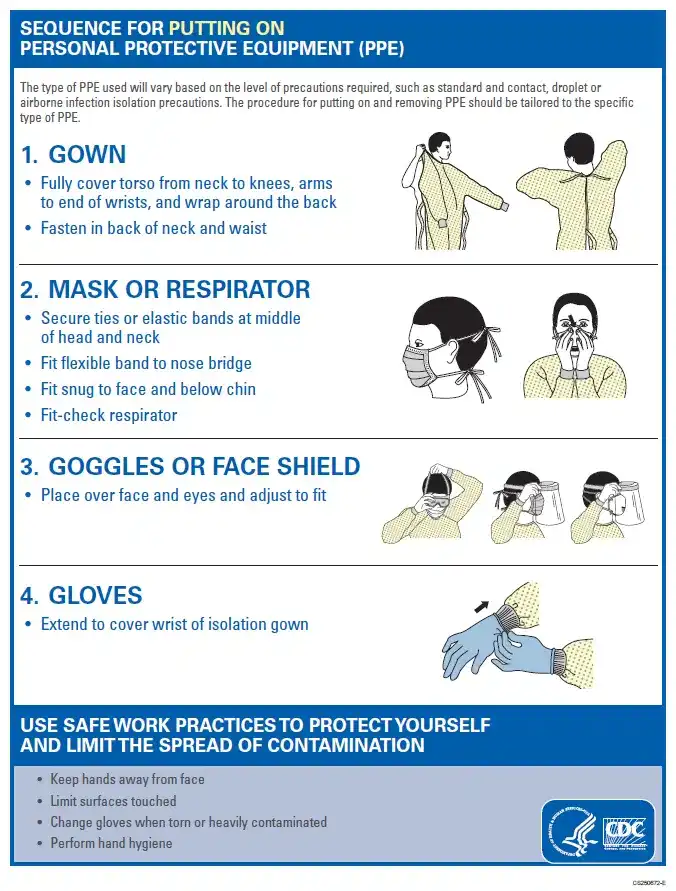
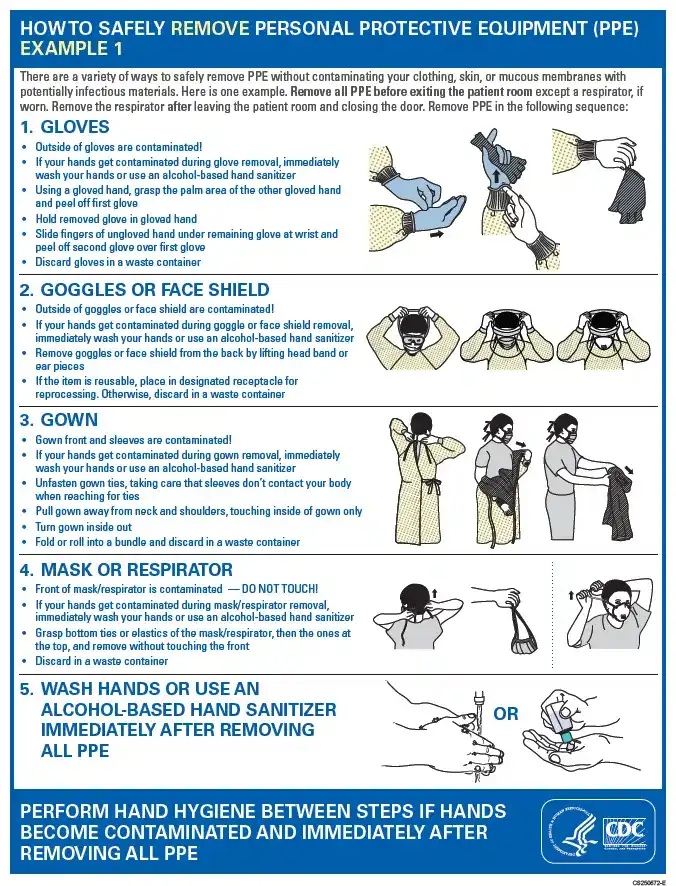
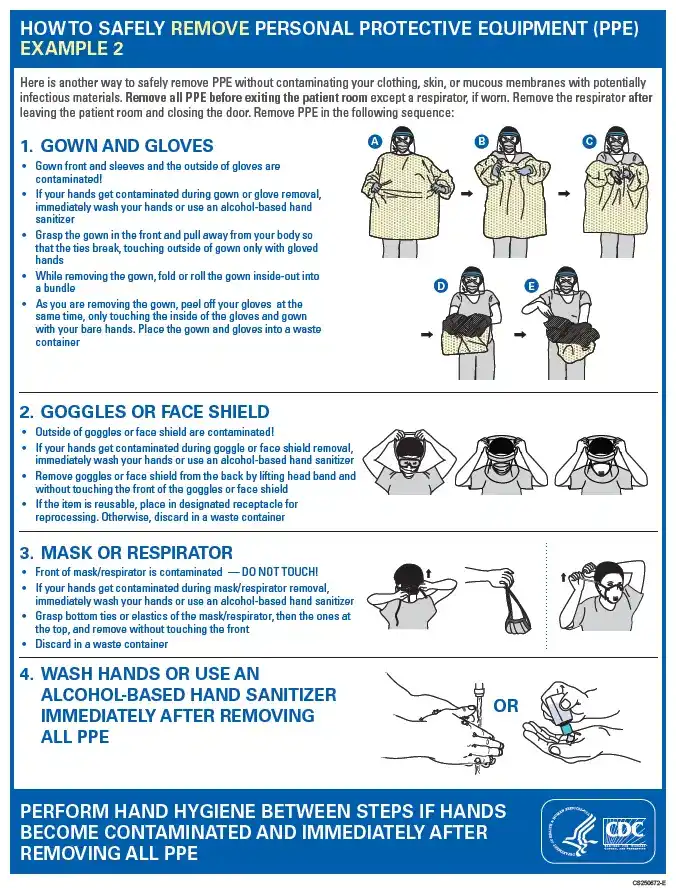
Personal Protective Equipment (PPE)
Things that are PPE;
- Gloves: various gloves protect against varying hazards, most commonly, medical grade Nitryl or latex gloves are used to protect against pathogenic hazards
- Body Protection; Most often varying forms of protective suits are worn to protect from pathogenic hazards. In the case of facilities with direct contact of known or suspected COVID-19 infectious subjects, Tyvek, full body suits can be worn. However! To be impervious to the maximum of the design, all seems should be sealed
- Eye/face protection; Eye protection should also be worn for those involved in the direct contact of known or suspected COVID-19 infectious subjects. Eye protection should provide side protection at the least. Face shield make excellent protection, especially when used in conjunction with eye protection.